The Cash Component Trap: Why Black Money Deals Hurt the Buyer Most (2026)


It is the standard whisper in a property dealer's office: "Sir, the price is ₹2 Crores. We will do the Registry at ₹1.2 Cr. Pay the rest in cash. You save Stamp Duty, I save Capital Gains. Win-Win."
In 2025, this is not a win-win. It is a trap. While the seller takes the risk of getting caught with cash, YOU (the buyer) take a guaranteed financial hit that often exceeds the "stamp duty savings" you were so happy about.
Here is the asymmetric reality of why clean, "White Money" deals win in the long run.
1. The "Future Tax" Bomb (Capital Gains)
This is the math nobody shows you. When you pay cash, you artificially lower your Cost of Acquisition.
- Scenario: You buy a villa for ₹2 Cr.
- The "Deal": you pay ₹1.2 Cr (White) + ₹80 Lakhs (Cash).
- Official Cost: ₹1.2 Cr.
5 Years Later: The market booms. You sell for ₹3 Cr (all white, because the new buyer is taking a home loan).
-
Your Taxable Profit: ₹3 Cr (Sale) - ₹1.2 Cr (Official Cost) = ₹1.8 Crores.
-
Capital Gains Tax (20%): ₹36 Lakhs.
-
Real Profit: You actually paid ₹2 Cr. Your real profit is only ₹1 Cr.
-
The Loss: You are paying tax on ₹80 Lakhs of "phantom profit" because you couldn't prove you paid it.
-
The Stamp Duty Saving: You saved ~6% on ₹80L = ₹4.8 Lakhs.
-
The Tax Hit: You paid ₹16 Lakhs extra in Capital Gains tax (20% of ₹80L).
Result: You lost ₹11.2 Lakhs by trying to be "smart" with cash.
2. The 100% Penalty (Section 269SS & 269ST)
The Income Tax Act is draconian regarding property cash transactions.
- Section 269SS: Prohibits accepting any loan/deposit/advance in cash >₹20,000.
- Section 269ST: Prohibits receiving >₹2 Lakhs in cash for any transaction.
- The Penalty: 100% of the cash amount.
- If a raid happens and your deal is exposed, the penalty isn't 10% or 20%. It is the entire cash component.
3. Benami Property & Confiscation
If the source of the cash cannot be explained (i.e., you used someone else's cash or undeclared income), the property can be provisionally attached under the Benami Transactions (Prohibition) Act.
- Unlike Tax Evasion (where you pay a fine), Benami laws allow the government to confiscate the asset entirely.
4. The "Banking" Blockade
In 2025, 90% of buyers use Home Loans.
- Banks never fund the cash component.
- If you need to pay ₹80 Lakhs in cash, you need that liquidity now.
- If you had kept that ₹80 Lakhs in a white market instrument (Mutual Funds/Stocks), it would have compounded. By liquidating it for a dead asset (cash), you lose the compounding opportunity cost.
Summary
The "Cash Deal" is a relic of the 2010s. In the era of digitized land records, AI-driven tax scrutiny, and rationalized stamp duty (like Dehradun's caps), the risks outweigh the rewards by 10x.
The Rule: If a seller insists on a high cash component, walk away. They are transferring their tax liability to your future self.
Safe Buying: Always follow the Legal Checklist and ensure every rupee is documented in the Sale Deed.
Read Next

TDS on Property Purchase India 2026: Section 194IA Step-by-Step Guide
Buying property over ₹50L? Section 194IA mandates 1% TDS deduction by buyer. Form 26QB filing, payment process, penalties for non-compliance — 2026 NRI seller rules included.
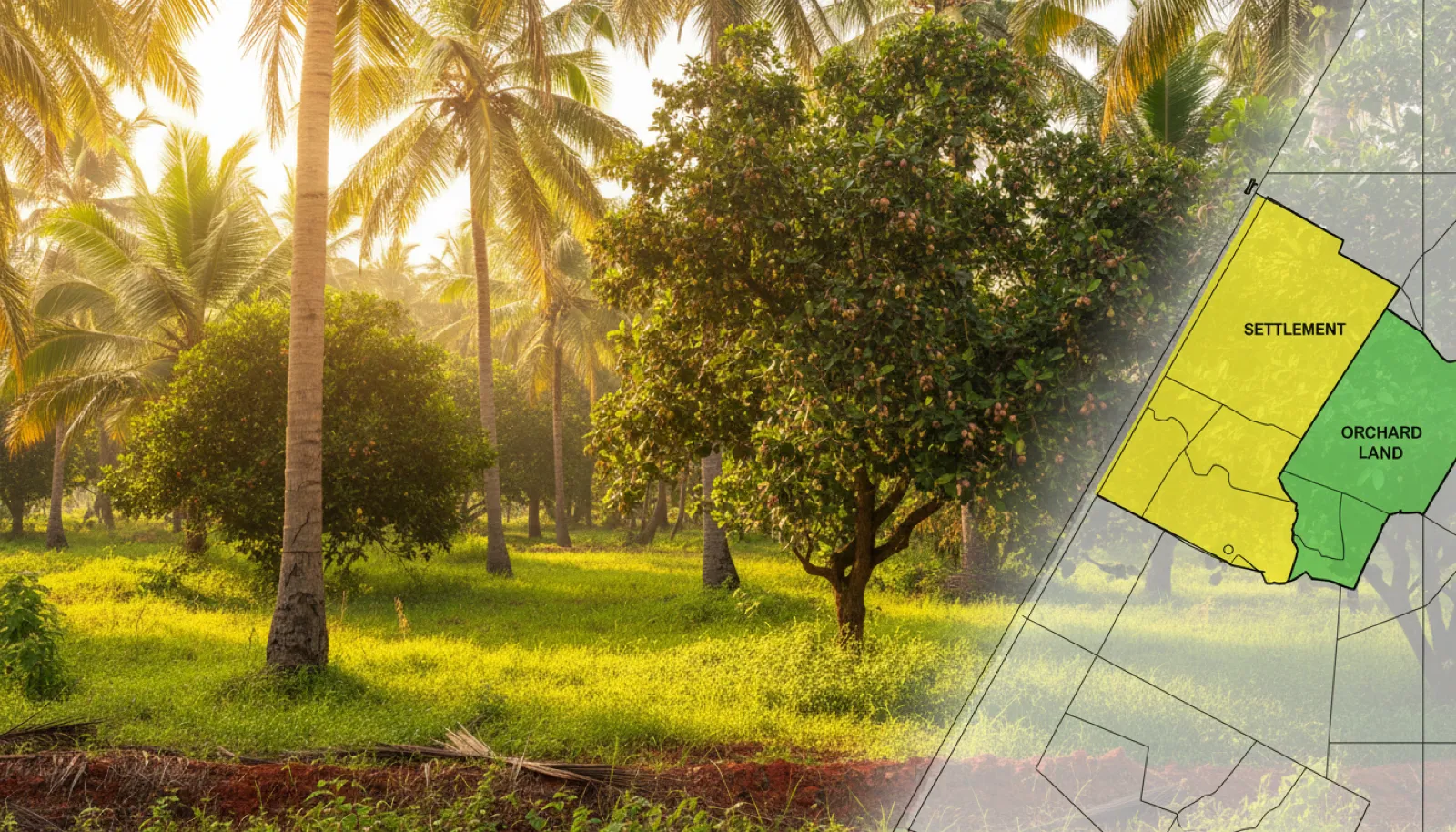
Orchard Land Meaning in Goa: What You Can Actually Do (2026)
What "orchard land" (often misheard as "orchid land") actually means in Goa — the RP21 green zone, what you can and cannot build, why the plots are cheap, and the conversion reality.

Sanad Conversion Cost in Goa: Fees, Slabs & Timeline (2026)
What a conversion Sanad actually costs in Goa — the notified per-sqm fee slabs, the 2024 fee revision, the document checklist, a worked example, and the honest timeline.