Orchard Land Meaning in Goa: What You Can Actually Do (2026)

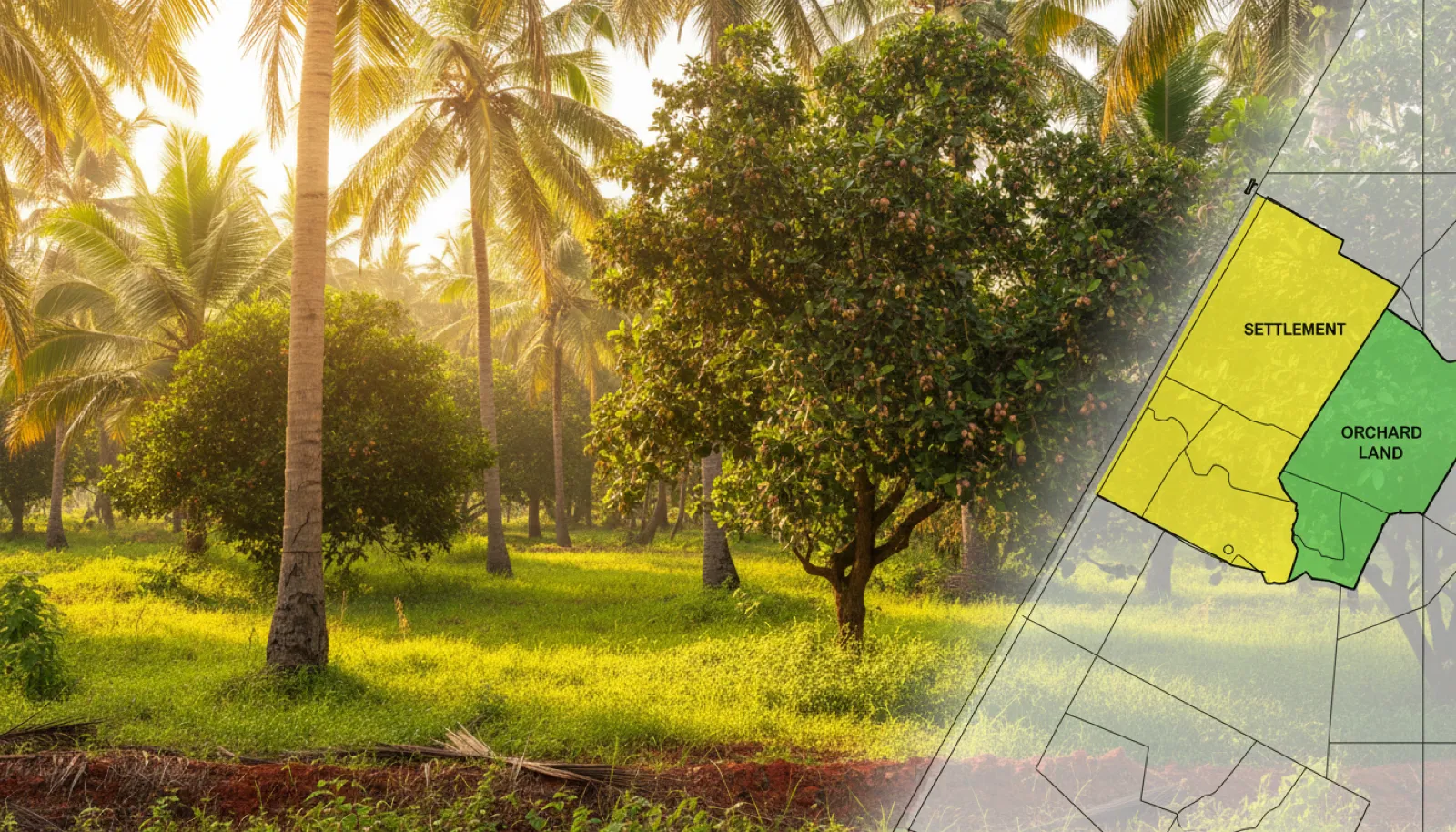
Orchard land in Goa is land zoned green — "Orchard / Natural Cover" — on the Regional Plan 2021 (RP21). It is agricultural-class land meant for cultivation (coconut, cashew, mango), not for housing. You cannot build an ordinary house on it, which is exactly why it is listed at a third to half the price of buildable land next door.
And no — it has nothing to do with orchids. Brokers say "orchard plot", buyers hear "orchid plot", and the misheard word ends up in listings. Same thing: green-zone agricultural land.
Orchard Land, Defined Properly
Every survey number in Goa carries a colour on the Regional Plan 2021:
- Yellow — Settlement. Residential/commercial use. You can build a house here (with a construction licence).
- Green — Orchard / Natural Cover. Cultivation land. Ordinary housing is not permitted.
- Blue — Eco-sensitive / CRZ. Coastal and protected land. Assume severely restricted.
"Orchard" is therefore not a description of what grows on the plot — plenty of green-zone plots are scrubland with no tree on them. It is a legal land-use classification. What matters is the colour on the zoning record, not what you see when you visit.
What You CAN Do on Orchard Land
Orchard land is not worthless — it is just not housing land. Legitimately, you can:
- Cultivate it — plantation, orchard crops, kitchen farming.
- Build a farmhouse — but only on a big plot. The rules require a minimum plot of roughly 4,000 sqm (about 1 acre), with ground coverage capped at 5–10%. On a 4,000 sqm holding that is a structure of about 200–400 sqm footprint, positioned as ancillary to agricultural use.
- Hold it as long-horizon land — with the honest acknowledgement that its value depends on zoning that may never change.
What You CANNOT Do
- Build an ordinary house or villa. A construction licence requires the zoning to permit it — Settlement, which orchard land by definition is not. And even on correctly-zoned land, if the recorded use is still agricultural you additionally need a conversion Sanad before building. An orchard plot fails at the zoning step itself, so a Sanad alone cannot rescue it.
- Build a farmhouse on a small plot. Buy a 400 sqm orchard plot and the farmhouse rule gives you nothing — the 4,000 sqm minimum means you own a garden.
- Buy it at all, if you are an NRI or OCI. Under FEMA, NRIs/OCIs cannot purchase agricultural land, plantation property or farmhouses anywhere in India — inheritance is the only legal route. Orchard land is agricultural-class, so the purchase itself is the violation, before any building question arises.
Orchard vs Settlement: The Comparison That Decides Price
| Orchard (green) | Settlement (yellow) | |
|---|---|---|
| Build a house? | No | Yes, with construction licence |
| Farmhouse? | Only on 4,000+ sqm, 5–10% coverage | Not needed — build a real house |
| Typical price | ~30–50% of Settlement | Baseline |
| Bank loan for construction | No | Yes, on clean title |
| NRI/OCI can buy? | No (FEMA bar) | Yes |
| Who it suits | Working farmers, large-estate holders | Home and villa buyers |
That price column is the whole story behind the "₹25 lakh river-view plot" listings: the discount is not a bargain, it is the market pricing in that you cannot build. The seller knows the zoning. The listing price is the disclosure.
"Can I Convert It to Settlement Later?"
This is the pitch attached to nearly every green plot in Goa: "buy now cheap, we'll convert, value triples." The 2026 reality is that a conversion Sanad changes a plot's recorded use, not its zone — a green-zone plot first needs a zone change, which is discretionary, litigated, and shut off entirely for paddy/Khazan land and survey numbers flagged as private forest. The honest odds for a small green plot are close to zero.
The full mechanics — what a Sanad is, the Section 32 process, why the "6-month conversion" promise fails — are in our main guide: Orchard Land in Goa: The "Sanad" Trap & Conversion Rules. And if you want the actual government fee schedule for a plot that is eligible, see the Sanad conversion cost and timeline breakdown.
How to Check What a Plot Really Is
Two documents settle it in under a day:
- Form I & XIV (record of rights) for the exact survey number and sub-division — states recorded land use and occupant. If the occupant is a Comunidade, stop and read why Comunidade land can't be bought the normal way.
- The RP21 overlay on the Goa DSLR portal, confirmed by a TCP Zoning Certificate. Yellow = buildable. Green = orchard. Blue = assume no.
Never rely on the listing, the broker's word, or the state of the neighbouring plots. Zone colours change at survey-number boundaries.
Frequently Asked Questions
What does orchard land mean in Goa?
Orchard land is land classified in the green "Orchard / Natural Cover" zone of Goa's Regional Plan 2021. It is agricultural-class land intended for cultivation. Ordinary residential construction is not permitted on it — only a farmhouse, and only on plots of roughly 4,000 sqm or more with 5–10% ground coverage.
What is an "orchid plot"? Is it different from an orchard plot?
They are the same thing. "Orchid plot" is a common mishearing/misspelling of "orchard plot" in Goa listings and conversations. Neither has anything to do with orchid flowers — it is green-zone agricultural land.
Can we build a house on orchard land in Goa?
No — not an ordinary house. The only structure permitted is a farmhouse, and only where the plot is at least about 4,000 sqm with ground coverage capped at 5–10%. Small orchard plots are effectively unbuildable, and no bank will finance construction on them.
Why is orchard land so cheap compared to settlement land?
Because you cannot build on it. Orchard plots typically trade at 30–50% of the price of comparable Settlement-zone land. The discount is the market's valuation of the missing right to build — not an arbitrage opportunity.
Can an NRI buy orchard land in Goa?
No. FEMA bars NRIs and OCI cardholders from purchasing agricultural land, plantation property, or farmhouses anywhere in India. Orchard land is agricultural-class, so the transaction itself is impermissible — an NRI can only acquire such land by inheritance.
Can orchard land become settlement land?
Only through a zone reclassification (Section 39A of the TCP Act), which is discretionary, heavily litigated, and barred outright for paddy/Khazan land and private-forest survey numbers. For most small green plots the realistic answer is no — see the full conversion guide.
The One-Line Rule
If the plan colour is green, price it as farmland — because that is what the law says it is. If you are buying to build, buy yellow: start with the Goa property buying checklist.
Read Next

Orchard Land in Goa: The "Sanad" Trap & Conversion Rules (2026)
Cheap "authorized" plots in Goa are usually Orchard (green-zone) land. Why you can't build on them, why NRIs can't legally buy them, how the Sanad / NA land- conversion process actually works, and what the 2026 rules really allow.

Sanad Conversion Cost in Goa: Fees, Slabs & Timeline (2026)
What a conversion Sanad actually costs in Goa — the notified per-sqm fee slabs, the 2024 fee revision, the document checklist, a worked example, and the honest timeline.
Comunidade Land in Goa: Why You Can't Actually Buy It (2026)
Comunidade land in Goa is owned collectively by the village and is legally inalienable — you cannot buy it outright. What aforamento really gives you, the 2025 reclaim rules, and why NRIs should walk away.