Orchard Land in Goa: The "Sanad" Trap & Conversion Rules (2026)


The scams in Goa don't happen in the villas; they happen in the dirt. You will see listings for "River view plots, 500 sqm, only ₹25 Lakhs". Meanwhile, the neighbour is selling for ₹1 Crore.
The difference isn't the view. It is the Zone. The cheap plot is Orchard (Green) Zone. The expensive one is Settlement Zone. In 2026, buying Orchard land hoping to "convert it later" is the fastest way to lose your capital — and if you hold an NRI or OCI passport, it is not just a bad investment, it is a transaction the law does not permit you to make at all.
What is a "Sanad"?
A Sanad is the official conversion order that changes a plot's recorded land use from Agricultural to Non-Agricultural (NA). It is issued by the office of the Collector / Deputy Collector under the Goa, Daman and Diu Land Revenue Code.
- No Sanad = no construction. You cannot legally pour a foundation on land that is still recorded as agricultural.
- A Sanad is plot-specific. It does not transfer; a Sanad on the neighbour's plot does nothing for yours.
- It is separate from, and comes before, the building permission ("construction licence") issued by the Panchayat or Municipality.
So a buildable Goa plot needs two clearances: the land-use clearance (Sanad / Settlement zoning) and then the construction licence. Brokers routinely conflate the two.
The Goa Zone Map: Where You Can and Cannot Build
Every survey number in Goa sits inside a colour on the Regional Plan 2021 (RP21). The colour, not the listing photo, decides what the land is worth.
| Zone (RP21 colour) | Build a house? | Typical price vs. Settlement | Who it is actually for |
|---|---|---|---|
| Settlement (yellow) | Yes — with a construction licence | Baseline (1x) | Anyone wanting a home or villa |
| Orchard / Natural Cover (green) | No — only a farmhouse, on 4,000+ sqm, 5–10% coverage | ~30–50% of Settlement | Working farmers; large-acreage estate buyers |
| Eco-sensitive / CRZ (blue) | Severely restricted; coastal-zone rules apply | Highly variable | Specialists only — assume "no" |
| Khazan / paddy (notified) | No — protected, conversion banned | Lowest | Not investors. Avoid. |
The "₹25 Lakh river-view plot" is almost always green or blue. The price gap is the warning label. (New to the terminology? Start with what "orchard land" actually means in Goa — including the "orchid plot" confusion.)
The "Orchard" Myth
Brokers will tell you: "Sir, buy now as Orchard. We will apply for a File 17(2) correction or zone change and get it converted in 6 months. Value will triple!"
The 2026 reality check:
- Strict ban on paddy conversion. The Goa State Amritkal Agriculture Policy 2026 has explicitly barred the conversion of paddy fields (Khazan / Kher).
- The spot-conversion loophole is closing. Goa courts have struck down arbitrary individual "spot conversions" under Section 17(2) of the TCP Act — the exact mechanism brokers promise.
- The farmhouse rule is a trap of its own. You can build a farmhouse on Orchard land, but:
- Minimum plot size: 4,000 sqm (roughly 1 acre).
- Ground coverage: only 5%–10%.
- Buy a 400 sqm orchard plot and you can build nothing. You own an expensive garden.
The "6-month conversion" is sold on every green plot in Goa. If it were that easy and that profitable, the seller would have done it themselves and charged you Settlement-zone price.
The NRI Red Line: FEMA Bars You From Orchard Land Entirely
This is the part most Goa brokers will not raise — because it kills the deal.
Under the Foreign Exchange Management Act (FEMA), a Non-Resident Indian or OCI cardholder cannot purchase agricultural land, plantation property, or a farmhouse in India. Residential and commercial property — yes. Agricultural-class land — no. The only legal route to holding such land is inheritance, never purchase.
Orchard land is, by its land-use classification, agricultural-class land. So for an NRI buyer the orchard plot is off the table twice over:
- The TCP problem — you cannot build on it (the issue for every buyer).
- The FEMA problem — you are not legally permitted to buy it in the first place.
An NRI who buys orchard land on a broker's "we'll convert it" promise is not making a risky investment — they are completing a transaction that can be challenged as a FEMA contravention, with the property exposed to proceedings. No rental yield or appreciation story survives that.
If you are an NRI or OCI: restrict yourself to Settlement-zone plots with the Sanad already in hand, or to RERA-registered residential projects. See our guide to what NRIs can and cannot buy in India for the full FEMA picture, and run every plot through a title-search checklist before releasing a token.
How to Check the Zone Before You Pay a Token
Don't trust the broker. Trust the records.
- Get the Survey Number and Sub-division of the exact plot — not the survey number of the larger parent holding.
- Pull the Form I & XIV (the record of rights) for that survey number. It states the recorded land use and the registered occupant. If the occupant column names a Comunidade instead of an individual, stop — the zone is now the least of your problems: see why Comunidade land can't be bought the normal way.
- Open the Goa Land Records (DSLR) portal and check the survey number against the Regional Plan 2021 map overlay:
- Yellow — Settlement. Buildable.
- Green — Orchard / Natural Cover. Do not buy to build.
- Blue — Eco-sensitive / CRZ. Assume restricted.
- Cross-check the Zoning Certificate issued by the Town & Country Planning department for that survey number. The DSLR overlay tells you the likely zone; the TCP Zoning Certificate is the document that confirms it.
- Ask for the Sanad itself if the seller claims the plot is already converted — and verify the Sanad's survey number matches the plot you are buying.
If a seller cannot produce a Zoning Certificate and (for a "converted" plot) the Sanad, the plot is not ready to build on, whatever the listing says.
How to Convert Land to Settlement / NA Use in Goa — The Real Process
When conversion is legally possible — a Settlement-compatible plot that is not paddy, not notified forest, not eco-sensitive — it runs through one official channel: a Conversion Sanad under Section 32 of the Goa, Daman and Diu Land Revenue Code, 1968 (and the 1969 Conversion Rules). Here is the real shape of it, so you can price a broker's "we'll convert it" promise honestly.
Where you apply depends on the plot size:
- Up to 500 sqm — the Deputy Collector & SDO of the taluka.
- Above 500 sqm — the Collector of the district.
What you file — a Schedule-I application bearing a ₹5 court-fee stamp, with:
- Title documents for the plot (notarised).
- A survey plan and a site / location plan.
- Form I & XIV mutated into the applicant's name, plus the manual Form I & XIV from the village Talathi.
What then happens:
- The authority calls for reports from the Town Planner (TCP), the Taluka Mamlatdar, and the Deputy Conservator of Forest. That forest report is where most green-zone files quietly die.
- If the reports are favourable, the Survey Department draws up the proposed NA property plan.
- The conversion fee is assessed on the survey report — there is no flat public rate; it scales with area and zone — and paid.
- Only then is the Sanad issued.
The honest cost and timeline: the application itself is nominal (a ₹5 stamp); the real money is the conversion fee, calculated case by case — we've broken down the notified per-sqm fee slabs with a worked example here. The government publishes no fixed timeline — for a clean, Settlement-compatible plot it can take months; for anything touching green, paddy or forest land it stretches into years, if it completes at all.
And here is the catch the "6-month conversion" pitch hides: a Sanad converts land use, it does not rezone the land. If the plot sits in the Orchard (green) zone on the Regional Plan, you first need a zone change — a separate and far harder fight:
- The old spot-conversion route under Section 17(2) of the TCP Act has been struck down by the Goa courts.
- A newer route — Section 39A of the TCP Act — does let owners apply to reclassify orchard / paddy / slope land to Settlement, but it is discretionary, has drawn court challenges and forest-department scrutiny, and the Supreme Court has already barred fresh conversion sanads on hundreds of survey numbers flagged as private forest.
- Paddy / Khazan conversion is banned outright under the Goa State Amritkal Agriculture Policy 2026.
So "yes, it can be converted" is true only for plots that were essentially Settlement-ready to begin with. For the cheap green-zone plot a broker wants to sell you on a conversion promise, the honest answer is usually no — and never at a price that treats the Sanad as a formality. "Six months" is a sales line, not a timeline.
Frequently Asked Questions
Can I build a house on Orchard land in Goa?
No — not an ordinary house. Orchard land permits only a farmhouse, and only if the plot is at least 4,000 sqm, with ground coverage capped at 5%–10%. A small orchard plot is effectively unbuildable.
Can an NRI buy Orchard or agricultural land in Goa?
No. Under FEMA, NRIs and OCI cardholders cannot purchase agricultural land, plantation property, or farmhouses anywhere in India. Such property can only be acquired by inheritance. NRIs should restrict themselves to Settlement-zone plots or RERA-registered residential property.
How do I confirm a plot is in the Settlement zone?
Get the exact survey number, pull the Form I & XIV, check the survey number against the Regional Plan 2021 overlay on the Goa DSLR portal, and obtain the TCP Zoning Certificate. The Zoning Certificate is the document that formally confirms the zone.
Is the "6-month conversion" promise reliable?
No. Spot conversions under Section 17(2) of the TCP Act have been struck down by Goa courts, and paddy-field conversion is banned outright under the 2026 agriculture policy. Even for an eligible plot, conversion is a multi-year, uncertain process — never a guaranteed six months.
What is the difference between a Sanad and a construction licence?
A Sanad changes the land's recorded use from agricultural to non-agricultural. The construction licence, issued separately by the Panchayat or Municipality, permits the actual building. You need the Sanad (or Settlement zoning) first, then the licence.
How do you convert agricultural or orchard land to NA use in Goa?
You apply for a Conversion Sanad under Section 32 of the Goa, Daman and Diu Land Revenue Code — to the Deputy Collector & SDO for plots up to 500 sqm, or to the Collector above that. You file a Schedule-I application with the title documents, survey plan, site plan and a mutated Form I & XIV. The office then takes reports from the Town Planner (TCP), the Mamlatdar and the Deputy Conservator of Forest; if those clear, the conversion fee is assessed on the survey report and the Sanad is issued. It only works where the zoning already permits non-agricultural use.
Can orchard land be converted to settlement zone in Goa?
Rarely, and never as a formality. A Sanad changes a plot's use, not its zone — to move land out of the Orchard (green) zone you need a reclassification under Section 39A of the TCP Act, which is discretionary, has been challenged in court, and excludes paddy fields and survey numbers flagged as private forest (the Supreme Court has barred sanads on hundreds of those). For most cheap green-zone plots sold on a "we'll convert it" promise, the realistic answer is no.
Summary
If you are an outsider — and especially if you are an NRI — buying for a second home, the rule is simple: buy Settlement land with the Sanad already in hand.
Yes, it costs more. But it comes with the legal right to build, and it does not expose you to a FEMA challenge. Orchard land is for working farmers, not for investors hoping to game a conversion that the 2026 rules have largely shut down.
Next step: Once you have secured a Settlement plot, read the North vs. South Goa guide to decide what to build on it — and the Goa land-law comparison if you are weighing the Maharashtra border as an alternative.
Read Next
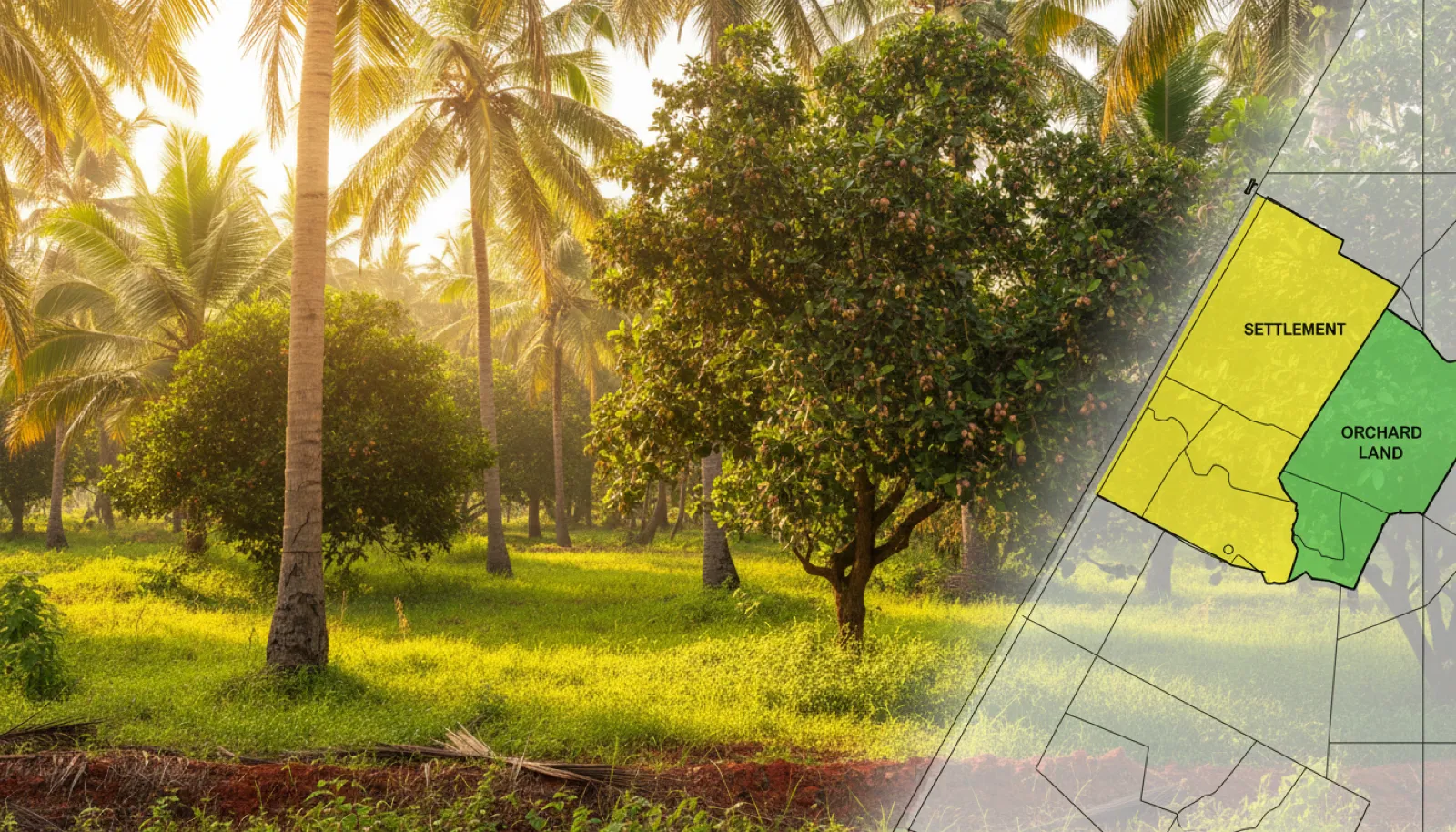
Orchard Land Meaning in Goa: What You Can Actually Do (2026)
What "orchard land" (often misheard as "orchid land") actually means in Goa — the RP21 green zone, what you can and cannot build, why the plots are cheap, and the conversion reality.

Sanad Conversion Cost in Goa: Fees, Slabs & Timeline (2026)
What a conversion Sanad actually costs in Goa — the notified per-sqm fee slabs, the 2024 fee revision, the document checklist, a worked example, and the honest timeline.
Comunidade Land in Goa: Why You Can't Actually Buy It (2026)
Comunidade land in Goa is owned collectively by the village and is legally inalienable — you cannot buy it outright. What aforamento really gives you, the 2025 reclaim rules, and why NRIs should walk away.