Vengurla vs. Goa for a Second Home: The Honest Comparison (2026)

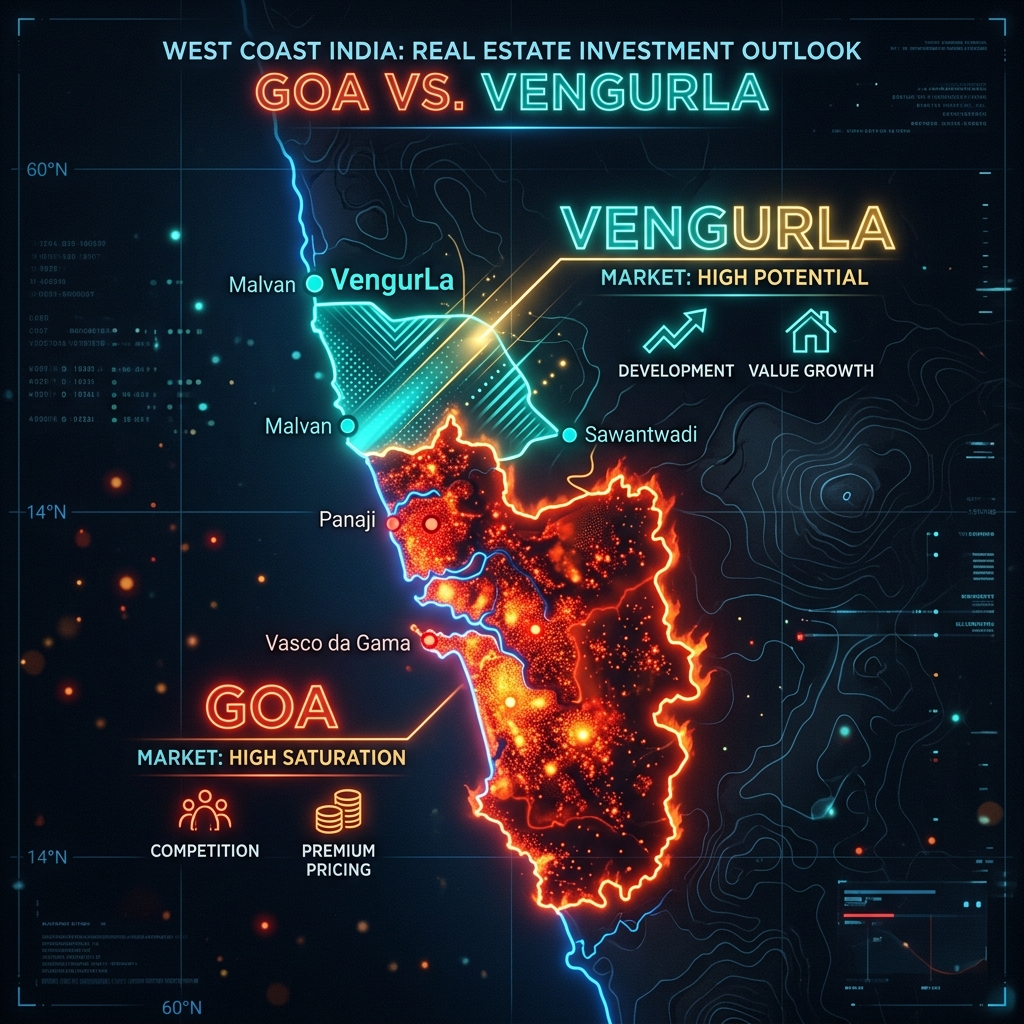
The pitch goes like this: "Sindhudurg is what Goa was twenty years ago." A broker will say it. A developer brochure will imply it. Your friend who just put down a token amount will repeat it over dinner.
It might be right. But "might be" and "twenty years ago" are doing a lot of work in that sentence.
The Goa-2005 comparison is the dominant sales narrative for every coastal Maharashtra project right now. The logic is clean: Goa got expensive, Sindhudurg is cheap, therefore Sindhudurg is next. Entry is cheap, upside is asymmetric, early movers win. Buy now.
The problem with clean logic is that it tends to skip over the messy facts. What does the price gap actually look like when you convert both markets to the same unit? Which airport is genuinely usable today? What does CRZ classification do to your build rights? What happens when you try to exit in four years and the buyer pool is thinner than expected?
Those are the questions this post answers. No promotional bias toward either market. Both have a case. You need to decide which case fits your situation.
The Price Gap: Real Numbers, Not Marketing Copy
The headline number is correct: Vengurla land is substantially cheaper than North Goa. The details matter, though, because the comparison is not apples-to-apples in several ways.
| Metric | North Goa (Assagao / Anjuna) | Vengurla / Kondura belt |
|---|---|---|
| NA plot price, sea-view | ₹8,000–13,000/sq yard (~₹890–1,440/sqft) | ₹5–7L/guntha (~₹459–643/sqft) |
| Gated project entry | ₹1–1.5 Cr for ~150 sqm | ₹25,000/sqm (Baywatch Kondura) → ₹1.26 Cr for 500 sqm |
| Open-market NA (good location) | ₹1.5–2 Cr for ~200 sqm | ₹50–80L for 10–15 guntha (~10,900–16,300 sqft) |
| What ₹1 Cr buys you | ~100–120 sqm (one large room) | ~3–4 guntha (~3,200–4,350 sqft) sea-view NA plot |
1 guntha = 1,089 sq ft = 101.17 sq meters.
The 85% price arbitrage is real. A ₹1 crore budget buys you a fraction of a plot in Anjuna and a proper estate in Kondura. That is not spin — it is arithmetic.
What the comparison obscures is that both markets have appreciated significantly from their respective bases. North Goa already ran its appreciation cycle; you are buying at the peak of a mature market. Vengurla NA plots were at ₹1.5–2.5L per guntha before 2019, moved to ₹3–5L post airport inauguration in 2022–2023, and now sit at ₹4–7L for prime coastal NA plots in 2026. That is a 2–3x move over five years — meaningful, but not the 24–30% per year figure that developers like to quote in their brochures. Independent cross-checks of portal listing data suggest 10–15% per year is a more defensible estimate for prime NA plots going forward.
The two markets are not necessarily in different phases of the same cycle. They are different propositions for different buyer types. Understanding which buyer type you are matters more than the price delta.
Airport Reality Check: Mopa vs. Chipi
This is the section where most developer content misleads buyers. The airport story in Sindhudurg is genuinely complicated, and oversimplifying it does investors a disservice.
Mopa Airport (GOX — North Goa): Fully operational as of late 2022. Serves Mumbai, Delhi, Bengaluru, Hyderabad, Chennai, and 10+ other cities. Located 50–70 km from Vengurla — roughly 60–75 minutes drive on NH66. If you are flying into this region from anywhere in India right now, Mopa is your most reliable option.
Chipi Airport (SDW — Sindhudurg / Vengurla): Opened October 9, 2021. Located in Vengurla taluka, approximately 25–30 km from Vengurla town and 21 km from Malvan. The Mumbai route — the route that would make this airport transformative — is currently suspended. As of June 2026, Fly91 operates routes to Bengaluru, Hyderabad, and Pune. The airport recorded only 17,618 passengers in the entire financial year 2024. The Maharashtra government has committed to restarting the Mumbai connection, but there is no confirmed restart date.
What this means in practice: For now, both markets are served primarily by Mopa. If you fly into Goa, you are already 60–75 minutes from Vengurla. The airport is not a current advantage for Sindhudurg buyers — it is a potential future advantage. If and when the Mumbai–Chipi route restarts with consistent frequency, that changes the calculus. A 45-minute Mumbai–Chipi flight would be a genuine demand catalyst that Goa cannot match. Until then, treat the airport as a thesis, not a reality.
The honest version of the airport story: Vengurla currently relies on the same airport as North Goa, just with a longer drive at the end.
CRZ Complexity: Is Goa Actually Simpler?
Coastal Regulation Zone rules exist in both states and affect both markets. The question is how significantly, and where the burden falls.
In North Goa's developed belts — Anjuna, Calangute, Baga — much of the coastal strip is classified CRZ-II, which applies to built-up municipal areas and is considerably more permissive. Construction is allowed subject to local body rules, and the stock of existing structures reduces the effective no-development constraint. Rural pockets in North Goa still carry CRZ-III classification with the associated restrictions.
In Sindhudurg — and specifically in the Kondura/Vengurla belt — the coastal classification is predominantly CRZ-III. Under CRZ-III rules:
- 0–200m from the High Tide Line (HTL): Complete No Development Zone. No construction is ever permitted. Not now, not after permissions, not with any workaround. This is an absolute prohibition.
- 200–500m from HTL: Restricted construction zone. Maximum 33% coverage, maximum 9 metres height (two floors), and only under traditional/local use conditions.
- 500m+ from HTL: Normal NA plot rules apply. Buildable with standard municipal and panchayat permissions.
In practice, CRZ creates a material risk in both states. The difference is that in Kondura/Vengurla, a higher proportion of the most desirable plots — the ones marketed as "sea-view" or "near the beach" — sit within or close to the restricted zone. A plot with a legitimate sea view at 800 metres from the HTL is fine. A plot marketed as "beachfront" that sits at 150 metres is unbuildable, regardless of what the broker says.
Broker assurances on CRZ status are not legally binding. Verify your specific plot's HTL distance using CZMP maps at czmp.ncscm.res.in and confirm with MCZMA (Maharashtra Coastal Zone Management Authority) before paying anything.
Goa adds its own legal complexity through the Sanad system and zone conversion requirements. That is a separate set of due diligence — see the Sanad conversion guide for details.
Neither market is CRZ-free. Sindhudurg's emerging market means fewer transactions have already surfaced the problem plots. Buyer beware applies more in Vengurla precisely because the documentation trail is thinner.
Rental Yield: Where Can You Actually Earn?
If rental income is part of your thesis, the two markets look meaningfully different.
North Goa (Anjuna / Vagator / Morjim / Assagao): This is an established short-term rental market with genuine global demand. Well-finished villas with pools earn ₹15,000–40,000 per night at peak, with occupancy running 60–70% annualised. The shoulder season and monsoon dip the average, but the Goa brand sustains year-round traveller interest — digital nomads, long-stay Europeans in winter, domestic weekend travellers, weddings. Net rental ROI on invested capital typically lands at 5–8%. The reason it is not higher is the denominator: capital costs are so elevated that even strong gross yields compress the net figure.
Vengurla / Kondura: The rental market exists but is early-stage. Boutique homestays and small guesthouses have demonstrated demand — primarily wellness retreats, surf travellers, family getaways from Mumbai and Pune, and NRI visitors during the October–February season. Well-finished villas with pools can command ₹10,000–25,000 per night during peak season. Occupancy is lower — realistically 35–50% annualised, because the monsoon (June–September) is effectively dead for leisure rentals, and the brand pull is weaker than Goa outside of a niche audience.
The math on yield is more favourable in Vengurla because the capital outlay is lower. On a ₹75L investment, a modest ₹8–10L annual net rental return is 10–12% ROI. The same return on a ₹2 Cr Goa villa is only 4–5%.
The honest qualifier: Vengurla is not a party destination. Rental demand is structurally different — fewer bachelor weekends, fewer international bookings, more family-driven and wellness-driven. If your rental model depends on volume and brand recognition, Goa is the safer bet. If you are building for a niche traveller who specifically wants seclusion and is willing to seek it out, Vengurla's yield math is compelling.
Liquidity and Exit: The Argument Nobody Makes
Most comparison content focuses on entry. The more important question for investors — as opposed to end-users — is exit.
North Goa: Deep secondary market. Resale transactions in Anjuna, Assagao, Vagator, and Morjim happen at scale every month. Portals like 99acres and MagicBricks list hundreds of resale properties across this belt at any given time. If you need to exit within 6–12 months at a reasonable price, it is realistic. You may not get your maximum aspirational number, but you will find a buyer.
Vengurla / Kondura: Thin secondary market. The buyer pool for resale NA plots in Kondura is materially smaller than in North Goa. Developer re-sales from projects like Baywatch and Mango Courtyard exist but are sporadic. There is no established community of property investors who regularly trade this micro-market. If you need to exit in three years, plan for 12–24+ months to find the right buyer at the right price. Distressed exits in thin markets require discounting.
This is the most important dimension of the "20 years ago" thesis, and the one that developers never mention. Goa's early buyers in 2002–2008 did extremely well — but they also held for 7–10 years before the secondary market was liquid enough to exit cleanly and at full value. The appreciation was real. The holding period requirement was also real.
The implication is direct: if your time horizon is under 5 years, the liquidity risk in Vengurla is meaningful and Goa is the lower-risk choice. If your horizon is 7–10+ years and you can genuinely wait, Vengurla's price upside combined with the infrastructure tailwinds (NH66 complete, MSH-4 coastal highway in construction, Chipi airport restart pending) makes a more compelling risk-adjusted case.
Do not let the price gap be the only argument you evaluate. A cheap entry into an illiquid market is only an advantage if you can hold long enough for the market to deepen.
Who Should Buy Where: A Persona Map
Buy in Goa if:
- Your holding horizon is under 5 years and you need a credible exit path.
- You want established, year-round rental income from day one, with a platform of existing property managers and OTA demand.
- You will use the property frequently and want proximity to established dining, nightlife, and social infrastructure.
- You are buying for lifestyle and capital preservation, not speculative appreciation.
- You have a budget above ₹1.5 Cr and are comfortable paying the Goa premium for the Goa product.
Buy in Vengurla/Kondura if:
- Your horizon is 7–10 years and you can hold through a thin-market period without needing to exit.
- You are building to live — a family retreat, a wellness getaway, an estate — rather than buying a purely financial instrument.
- You value seclusion, clean coastline, and low density over nightlife and social infrastructure.
- You have ₹60L–1.2 Cr and want scale: an actual estate with build rights and land area that the same budget cannot buy anywhere in Goa.
- You believe in the infrastructure thesis — NH66 four-laning complete, MSH-4 coastal highway (Revas to Redi) under construction with a December 2026 build target on key sections, Chipi airport Mumbai restart as a forthcoming catalyst — and want to be positioned before those catalysts fully price in.
NRI buyers specifically: both markets are accessible. NRIs can purchase NA plots in Maharashtra without RBI approval, subject to FEMA compliance and payment via NRE/NRO channels. Remote purchase via registered Power of Attorney is legal and common in both states. See the NRI property buying rules guide and the POA format and safety checklist before proceeding. This is informational content based on law as of 2026. NRI real estate transactions have FEMA, income tax, and RBI implications that vary by individual circumstances. Consult a qualified CA and advocate before transacting.
The "20 Years Ago" Thesis: What It Means and Where It Falls Short
The comparison is partially valid. The price gap is real. The airport exists. Government tourism investment in Sindhudurg is measurable — the ₹46.91 Cr INS Guldar underwater museum at Nivati Rocks (India's first — project initiated June 2025, the ship scuttled 19 May 2026; see the Nivati & Bhogwe land guide), the Tourism District designation, and the Taj Hotel at Shiroda-Velaghar (54.4-hectare, 90-year-lease allotment, tripartite agreement signed 18 August 2026 — see the Shiroda-Velagar Taj land guide) signal genuine state intent. The infrastructure trajectory — NH66 now complete through Sindhudurg, the MSH-4 coastal highway under active construction — is real and documented.
Where the thesis strains is on the demand driver. Goa in 2005 had an established global brand built over 30 years of backpacker and charter tourism. When the luxury conversion happened, it had an international buyer base — Israeli digital nomads, British second-home seekers, Southeast Asian stopover traffic. The brand did not need to be built from scratch; it needed to be repositioned.
Sindhudurg's growth thesis is more domestically concentrated. The primary demand comes from Mumbai, Pune, and NRI buyers from the Gulf and UK with Konkani roots. That is a real and growing demand base. It is not the same as an international lifestyle buyer market, and it probably produces a slower, steadier price curve rather than Goa's explosive 2006–2012 run. A real appreciation cycle — but a different shape.
The Taj Hotel also deserves an honest footnote here: that land was acquired by 1998 and allotted to IHCL in 2020, and the tripartite agreement was only signed on 18 August 2026 — 32 years after the 1994 proposal, with no opening date yet. A single high-profile project that took three decades to reach a signature is a useful reminder that announced anchors and built anchors are different things. Weight government project timelines conservatively.
Bottom Line
Both markets have a defensible case. This is not a situation where one is obviously right and the other is obviously wrong.
North Goa is a mature, liquid market with proven rental demand and a known exit path. You are paying the premium for all of that certainty. The upside from here is modest; the downside is limited.
Vengurla/Kondura is an early-stage market with real infrastructure tailwinds, genuine price arbitrage versus Goa, and a plausible appreciation thesis over a 7–10 year horizon. The illiquidity risk is real. The CRZ verification requirement is non-negotiable. The rental market is thinner than what developers suggest. If you can hold through those constraints, the risk-adjusted return case is more compelling than Goa at current Goa prices.
Do not let the price gap be the only argument. Liquidity, CRZ verification, and rental demand depth matter as much as the entry number. Match the market to your holding period, not your enthusiasm.
For a deeper look at either market, start with the Sindhudurg vs. North Goa investment overview or go directly to the Kondura and Vengurla buyer's guide for the full due diligence framework on the Sindhudurg side.
Next step: If Vengurla is the direction, start with the CRZ and NA status check — the Kondura beach buyer's guide covers what to verify before paying anything.
Read Next

Sindhudurg vs North Goa: The Per-Sq-M Land Price Math 2026
Side-by-side table: land price per sq m, stamp duty, land law, CRZ, NRI rules, airports, yields and exit depth — plus the one factor most buyers get wrong.

Investing in Kondura & Vengurla: The Unspoiled 'New North Goa' (2026 Guide)

Delhi-Dehradun vs. Delhi-Mumbai Expressway: Where is the Smarter Real Estate Bet?
A comparative analysis of India's two biggest expressway projects. Which corridor offers better ROI for land investors in 2025?