NRI Guide to Buying Coastal Land in Sindhudurg (2026)


You've been WhatsApped a listing. Coastal land near Kondura, Sindhudurg. ₹5 lakh per guntha. Beautiful photographs. The broker says "this is the next Goa, you should lock it before the coastal highway opens." You ask the obvious question: can I, as an NRI, actually buy this?
The answer is not a straight yes or no. It depends on which of two very different questions is hiding inside that one question.
If the plot is agricultural land — "Bagayat" or "Jirayat" on the 7/12 extract — the answer is a hard no. Non-farmers cannot purchase agricultural land in Maharashtra. If you buy it anyway, the penalty is not a fine. It is forfeiture of the land to the state under Section 63 of the Maharashtra Land Revenue Code.
If the plot carries a valid, stamped Non-Agricultural (NA) conversion order, the answer is yes. No RBI approval needed. Fully FEMA-compliant. Proceeds repatriable.
Most brokers presenting "coastal land near Vengurla" to NRIs are presenting agricultural land. Most articles covering "NRI property in Sindhudurg" conflate the two categories. This post does not.
The Short Answer: What NRIs Can (and Cannot) Buy in Sindhudurg
NRIs and OCIs can buy:
- Non-Agricultural (NA) residential plots — outright purchase, no RBI approval needed, FEMA Schedule 1 permissible transaction
- Built residential property (apartments, villas) on NA land
- Commercial property
NRIs and OCIs cannot buy:
- Agricultural land
- Plantation property (orchards, cashew estates)
- Farmhouses built on agricultural land
The only exceptions to the agricultural land prohibition are inheritance and gift from a relative. You cannot buy around this restriction through a company or a trust unless the company is itself a citizen of India and meets the farmer qualification under state law — which an NRI-controlled company generally will not.
The mechanism that separates these two categories is a single document: the 7/12 extract (Satbara Utara), available on Mahabhulekh at mahabhulekh.maharashtra.gov.in. Column 7 shows ownership. Column 12 shows land use and encumbrances. That column 12 entry is the first thing you check.
This is informational content based on law as of 2026. NRI real estate transactions have FEMA, income tax, and RBI implications that vary by individual circumstances. Consult a qualified CA and advocate before transacting.
Why Sindhudurg Is Different from Goa for NRI Buyers
NRIs frequently compare Sindhudurg to North Goa when evaluating coastal investments. The price differential is real — NA plots in the Vengurla-Kondura belt run ₹4–7 lakh per guntha today versus North Goa's ₹8,000–13,000+ per square yard — but the legal framework is also meaningfully different.
Goa's land title complexity is in a category of its own. You have the sanad system, the comunidade tenancy layer, the Town and Country Planning (TCP) conversion process, and a distinct colonial-era title lineage that requires specialist due diligence. If you're evaluating Goa alongside Sindhudurg, read the sanad conversion guide and the comunidade land explainer before drawing comparisons.
Maharashtra's NA plot framework is more straightforward for a buyer who knows what to look for. There is no sanad equivalent. There is no orchard-zone reclassification trap of the kind that catches buyers in Goa's rural talukas. Once a plot has a valid, stamped NA Order, the category is clear, the construction permission process is standard, and the title chain follows Maharashtra's land records system.
The primary complication in Sindhudurg's coastal belt is not zone classification — it is the Coastal Regulation Zone. We will cover that in a dedicated section below.
The other practical advantage for NRI buyers: purchasing through a Power of Attorney is legally common and well-understood in Maharashtra. You do not need to fly to India to execute the registration. A properly executed, apostilled POA appointing a trusted representative in Sindhudurg is the standard approach.
For a comparison of investment fundamentals between this coast and North Goa, see Sindhudurg vs North Goa Real Estate.
FEMA Rules That Apply to Coastal NA Plots
The Foreign Exchange Management Act, 1999 (FEMA), through its Schedule 1, permits Non-Resident Indians and Overseas Citizens of India to purchase immovable property in India — with two explicit exceptions: agricultural land and plantation property. An NA residential plot in Sindhudurg falls outside both exceptions and is a permissible transaction.
No RBI approval is required. This is a common misconception. Prior to 2003, NRIs needed specific RBI clearance for property purchases. That requirement was lifted. Today, the purchase of an NA plot or residential property by an NRI is a general permission under FEMA, not a specific permission requiring case-by-case RBI approval.
Payment channels matter. All payments must be routed through Indian banking. Two options:
- NRE account (Non-Resident External): Funded with foreign currency converted on remittance. Both the principal and any capital gains are freely repatriable. Tax-free in India on interest earned. This is the cleaner channel for investment purchases.
- NRO account (Non-Resident Ordinary): Funded with India-sourced rupee income or inward remittances. Repatriation is permitted up to USD 1 million per financial year after tax, subject to 15CB/15CA certification by a CA.
Do not pay in cash. Do not pay by direct foreign currency transfer to a seller's account outside Indian banking. Either will create title and FEMA compliance issues that are extremely difficult to reverse.
For a detailed breakdown of which account to use and when, see NRE vs NRO Account for Property Transactions.
Repatriation on sale: Proceeds from the sale of up to two residential properties can be repatriated through your NRE or NRO account. The amount repatriable is capped at the original investment made in foreign exchange — gains above that amount are repatriated from the NRO account within the USD 1 million annual limit. TDS obligations apply. See NRI Money Repatriation from India Property Sale for the full process.
The Agricultural Land Trap (Section 63 of the Maharashtra Tenancy and Agricultural Lands Act, 1948)
This is where most NRI buyers in Sindhudurg get into trouble, not through deliberate fraud on the seller's part, but through a combination of loose language and motivated ambiguity.
A broker describing a 10-guntha parcel near Vengurla as "land" or "investment land" or even "plot" without qualifying it as NA is, technically, describing something. The question is what. In Sindhudurg's Vengurla and Sawantwadi talukas, a very large proportion of land parcels remain agricultural. When a broker shows you land at ₹80,000 to ₹2.25 lakh per guntha, you are almost certainly looking at agricultural land. NA plots in the same belt currently trade at ₹4–7 lakh per guntha. The gap is the conversion premium — and it reflects both the cost and the legal status.
Section 63 of the Maharashtra Land Revenue Code (MLRC) prohibits the transfer of agricultural land to a person who is not an agriculturist as defined under the Act. The definition of agriculturist refers to a person who cultivates land personally in Maharashtra. An NRI does not meet this definition. Neither does most urban Indian buyers.
Non-farmers cannot purchase agricultural land in Maharashtra under Section 63 of the Maharashtra Land Revenue Code. Penalties include forfeiture of the land to the state.
How to spot agricultural land on a 7/12 extract:
- Column 12 showing "Bagayat" — irrigated agricultural use (orchards, paddy, vegetable cultivation)
- Column 12 showing "Jirayat" — rain-fed agricultural use (dryland crops)
- Column 12 showing "Zudpi Jungle" — scrub forest, a government category with its own restrictions
What you want to see in Column 12:
- "NA" (Non-Agricultural) — indicates conversion has been completed
- "Gavan Zamin" — a village land category that, in certain contexts, may be buildable, but requires independent verification
When you pull the 7/12, also verify whether there is a separate stamped NA Order. The 7/12 is a record of what has been filed and recorded — the NA Order is the actual legal permission. Both must be present and consistent.
"Proposed NA" vs. Stamped NA Order — The Most Common Trap
If you've been active in the Konkan property market for any length of time, you will encounter this: a 7/12 extract where Column 12 reads "Proposed NA" or where the broker tells you "NA is applied for, it's just waiting for approval."
This is not the same as having a stamped NA Order. Not even close.
A "Proposed NA" entry on a 7/12 extract means the conversion application has been filed. It does not mean construction is permitted. Wait for the stamped NA Order from the Collector (under MLRC §44) before paying any token or signing any agreement.
The NA conversion process in Maharashtra involves an application to the Collector (under MLRC §44), payment of a conversion premium (50% of the government ready reckoner / circle rate value for residential use), and the issuance of a formal NA Order bearing the Collector's or designated officer's seal. Until that Order is in hand, the land is legally agricultural.
Sellers frequently price "Proposed NA" land at or near actual NA plot rates while representing it as functionally equivalent. It is not. The conversion can be refused. It can be delayed by years. In coastal areas, it can be refused specifically because of CRZ constraints — which means a plot that is both "Proposed NA" and within the CRZ setback zone may never receive conversion at all.
The due diligence step is simple: ask for the stamped NA Order number and date. Cross-check it with the Collector's office records. If it doesn't exist, walk away or price the land as agricultural.
CRZ for NRI Buyers: The Coastal Setback Rule
The Coastal Regulation Zone rules apply equally to resident Indians, NRIs, and foreign nationals. Your citizenship status does not change your construction rights relative to the High Tide Line.
In the Kondura and Vengurla coastal belt, the applicable classification is CRZ-III (rural coastal area). The restrictions are:
| Distance from High Tide Line (HTL) | Restriction |
|---|---|
| 0–200m | No Development Zone. No construction, ever. No exceptions. |
| 200–500m | Restricted zone. Maximum 33% ground coverage, maximum 9m height (2 floors), traditional coastal use conditions only. |
| 500m+ | Standard NA plot rules apply. Buildable with normal permissions. |
"Sea-view plot" and "beachfront plot" are marketing descriptions, not CRZ categories. A plot marketed as having sea views could be anywhere from 50m to 2km from the HTL. The distance from the HTL is the only number that matters legally.
Verify your specific plot's HTL distance using CZMP maps at czmp.ncscm.res.in and confirm with MCZMA (Maharashtra Coastal Zone Management Authority) — broker assurances on CRZ status are not legally binding.
The practical implication for NRI buyers: plots in the 0–200m band may show up on portals as NA plots at attractive prices. They are effectively unbuildable. Plots in the 200–500m band can be developed but with severe height and coverage constraints that make villa construction workable only on larger parcels. Plots beyond 500m from the HTL operate under standard NA rules and are the cleanest category for residential development.
For a fuller discussion of the Kondura coastal belt and what's happening with land prices there, see the Kondura-Vengurla Investment Guide.
Step-by-Step: How an NRI Executes a Sindhudurg Plot Purchase From Abroad
This is the sequence. Each step is a gate — do not advance until the prior step is satisfied.
Step 1: Identify the plot and confirm NA status
Pull the 7/12 extract from Mahabhulekh using the survey number and taluka. Check Column 12. If the entry is agricultural, stop. If it shows NA or Gavan Zamin, proceed. Then ask for the physical stamped NA Order — the document, not a photograph of it, and not just the broker's assurance. Verify the Order number against the Collector's office records.
Step 2: Verify CRZ
Get the survey number's coordinates (from the 7/12 or the sub-registrar map) and locate it on the CZMP maps at czmp.ncscm.res.in. Determine the distance from the High Tide Line. If it's within 500m, understand what restrictions apply before proceeding. For plots within 200m: do not buy.
Step 3: Commission a 30-year title search
Engage a Sindhudurg-based advocate — not a Mumbai advocate, not a broker's recommended notary — to run a title search covering at least 30 years of ownership history for the specific survey number. The search will surface any pending litigation, encumbrances, mortgage entries, co-ownership disputes, or forest/revenue land reclassifications. Also obtain an Encumbrance Certificate from the Sub-Registrar for the same period. For a complete due diligence checklist, see Property Title Search Checklist India.
Step 4: Execute a Power of Attorney
You do not need to travel to India to buy the plot. A POA grants a trusted person — family member, advocate, or CA — the authority to execute documents on your behalf in India.
The POA must:
- Specifically name the property (survey number, taluka, district)
- Grant authority for Agreement to Sell, Registration, and Mutation
- Be executed before a Notary Public in your country of residence
- Be apostilled (for countries that are signatories to the Hague Apostille Convention) or attested at the Indian Consulate/High Commission
- Be stamped and registered in India before use
For a detailed format and safety checklist, see NRI Power of Attorney Format and Safety.
Step 5: Agreement to Sell and token payment
Once due diligence is complete, sign an Agreement to Sell. Token payment (typically 5–10% of consideration) must be transferred via your NRE or NRO account to the seller's Indian bank account. Wire transfer with clear narration referencing the property purchase. Keep all SWIFT/NEFT records — these are your FEMA compliance evidence.
Step 6: Registration at the Sub-Registrar
Your POA-holder attends registration in person at the Sub-Registrar's office in the relevant taluka (Vengurla or Sawantwadi). Stamp duty in Maharashtra: 5% of consideration or ready reckoner value, whichever is higher, plus 1% Local Body Tax (LBT) plus approximately 1% registration charges. Budget 7% of the transaction value for stamp duty and registration in Sindhudurg district.
Step 7: Mutation of the 7/12
After registration, apply to the Taluka Inspector of Land Records for mutation — the update of Column 7 (ownership) on the 7/12 extract to reflect your name as the new owner. This is a separate administrative step from registration and typically takes 1–3 months. Follow up in writing. The mutation is what makes your ownership visible in the revenue records.
Step 8: TDS
TDS rules depend on the seller's residential status:
- Seller is a resident Indian: No TDS obligation on the buyer for a plot purchase under ₹50 lakh. Above ₹50 lakh, the buyer deducts 1% TDS under Section 194-IA and deposits with the income tax department via Form 26QB.
- Seller is an NRI: The buyer must deduct TDS at 20% (plus surcharge and cess) on the entire sale consideration under Section 195, regardless of the amount. The applicable rate may be lower under a Double Taxation Avoidance Agreement (DTAA) between India and the seller's country of residence, subject to the seller providing Form 10F and a tax residency certificate.
For the full breakdown of TDS obligations and capital gains treatment when you eventually sell, see NRI Capital Gains Tax and TDS on Property Sale.
Current Market Prices for NA Plots in the Vengurla-Kondura Belt
For context on what the market looks like right now (June 2026):
| Category | Price per Guntha | Price per Sqft (approx) | Notes |
|---|---|---|---|
| Agricultural land (inland, >3km from coast) | ₹80,000–2.25L | — | NRIs cannot buy. Listed here for comparison only. |
| NA plot — inland, 6–10km from coast, road-touch | ₹4–4.5L | ₹367–413 | Example: 10 guntha at ₹45L, Bowalekar Wadi, Vengurla |
| NA plot — sea-view / near coast, 1–3km from HTL | ₹5–7L | ₹459–643 | Example: 94 guntha Vengurla Lighthouse area at ₹5L/guntha |
| Gated project (RERA/pre-launch) | ₹7,000–9,500/sq yard | ₹630–855 | Sawantwadi belt premium projects |
| Innovest Baywatch Kondura | ~₹25,000/sqm | ~₹2,325 | 500–600 sqm plots, Phase 1. No public RERA number as of June 2026. |
| North Goa comparison | ₹8,000–13,000+/sq yard | ₹890–1,440+ | Reference benchmark |
1 guntha = 1,089 sq ft = 101.17 sq meters.
On price appreciation: NA plots in this belt have delivered roughly 2–3x in five years, from ₹1.5–2.5L per guntha pre-2019 to ₹4–7L per guntha today. Developer marketing materials frequently cite 24–30% per year. That figure is not supported by independent portal listing data. A more defensible estimate for prime NA plots in the Vengurla-Kondura belt is 10–15% per year over the medium term, contingent on infrastructure execution — specifically the Revas-Redi Coastal Highway, where bridge work is currently underway with a December 2026 target.
Frequently Asked Questions
Can an OCI (Overseas Citizen of India) buy land in Sindhudurg?
Yes. An OCI has the same property purchase rights as an NRI under FEMA for the purpose of buying immovable property in India. The agricultural land prohibition applies equally — OCIs cannot buy agricultural land either. For NA plots, OCIs follow the same process as NRIs.
Do I need RBI approval to buy an NA plot in Maharashtra?
No. The purchase of residential immovable property (including NA plots) by an NRI or OCI is a general permission under Schedule 1 of the FEMA (Acquisition and Transfer of Immovable Property in India) Regulations. No specific RBI approval is required. Compliance is automatic when payment is routed through NRE/NRO banking channels.
Can I buy a Sindhudurg plot through a company or trust?
Not straightforwardly. A foreign company or a company controlled by NRIs is not an NRI for the purpose of the FEMA Schedule 1 general permission. Companies that are citizens of India (incorporated in India, majority Indian resident ownership) can purchase property in India. An NRI investing through an Indian company structure may be able to acquire land, but this involves RBI approvals, FDI regulations, and corporate land acquisition rules that are entirely separate from the NRI personal purchase route. If you are considering this structure, you need a CA specialising in FEMA and cross-border transactions — not a general property lawyer.
What TDS applies when I eventually sell the plot?
When you sell as an NRI, the buyer is required to deduct TDS. The standard rate is 20% (plus applicable surcharge and cess) on long-term capital gains if the property is held for more than 24 months, or at applicable slab rates for short-term gains. If a DTAA applies between India and your country of residence, lower rates may apply — but the buyer needs your Form 10F and tax residency certificate to apply the DTAA rate at source. If excess TDS is deducted, you can claim a refund by filing an Indian income tax return. See NRI Tax on Rental Income India for the income tax context while you hold the property.
Can I rent out the plot or construct a villa and list it on Airbnb?
You can construct a villa on an NA plot that is CRZ-compliant and within applicable building bye-law limits. There is no restriction on an NRI owning a villa in India or earning rental income from it. Rental income earned in India is taxable in India — TDS of 30% applies to rent paid to NRIs (subject to DTAA relief). As a practical matter, short-term rentals (Airbnb) require the property to be managed locally; most NRI villa owners in Sindhudurg use a local property management agent. Your Indian rental income can be credited to your NRO account.
Can I repatriate the full sale proceeds if I sell later?
Repatriation is permitted, with limits. The principal amount originally remitted from abroad in foreign exchange is freely repatriable. Capital gains above the original foreign exchange investment are repatriable from the NRO account within the USD 1 million per financial year limit, after paying applicable Indian capital gains tax and obtaining 15CB certification from a CA. Repatriation of sale proceeds from more than two residential properties requires specific RBI permission. For the step-by-step process, see NRI Money Repatriation from India Property Sale.
The Bottom Line
The answer to "can I buy coastal land in Sindhudurg as an NRI?" is neither a blanket yes nor a blanket no. It is a question about what type of land you are looking at.
NA plot with a stamped NA Order: Yes. FEMA-compliant, no RBI approval needed, POA execution is standard, proceeds repatriable. This is a legal, accessible investment structure for NRIs and OCIs.
Agricultural land: No, regardless of how it is described in a listing or a broker's pitch. Section 63 of the MLRC is unambiguous. The penalty is forfeiture.
"Proposed NA": Not yet. Wait for the stamped NA Order. Price it as agricultural until then.
Sea-view plot within 200m of the High Tide Line: Do not buy. The No Development Zone restriction has no exceptions and cannot be waived.
Before you pay any token, confirm the NA Order exists and is stamped, verify the plot's HTL distance on the CZMP maps, run a 30-year title search through a Sindhudurg-based advocate, and route all payments through your NRE or NRO account. Have both a CA with FEMA experience and a local advocate in place before signing anything.
Next step: Once you've confirmed the plot is NA and CRZ-compliant, check the title search checklist for the full due diligence sequence, and review what NRIs can buy across India if you're evaluating multiple coastal markets in parallel.
Read Next
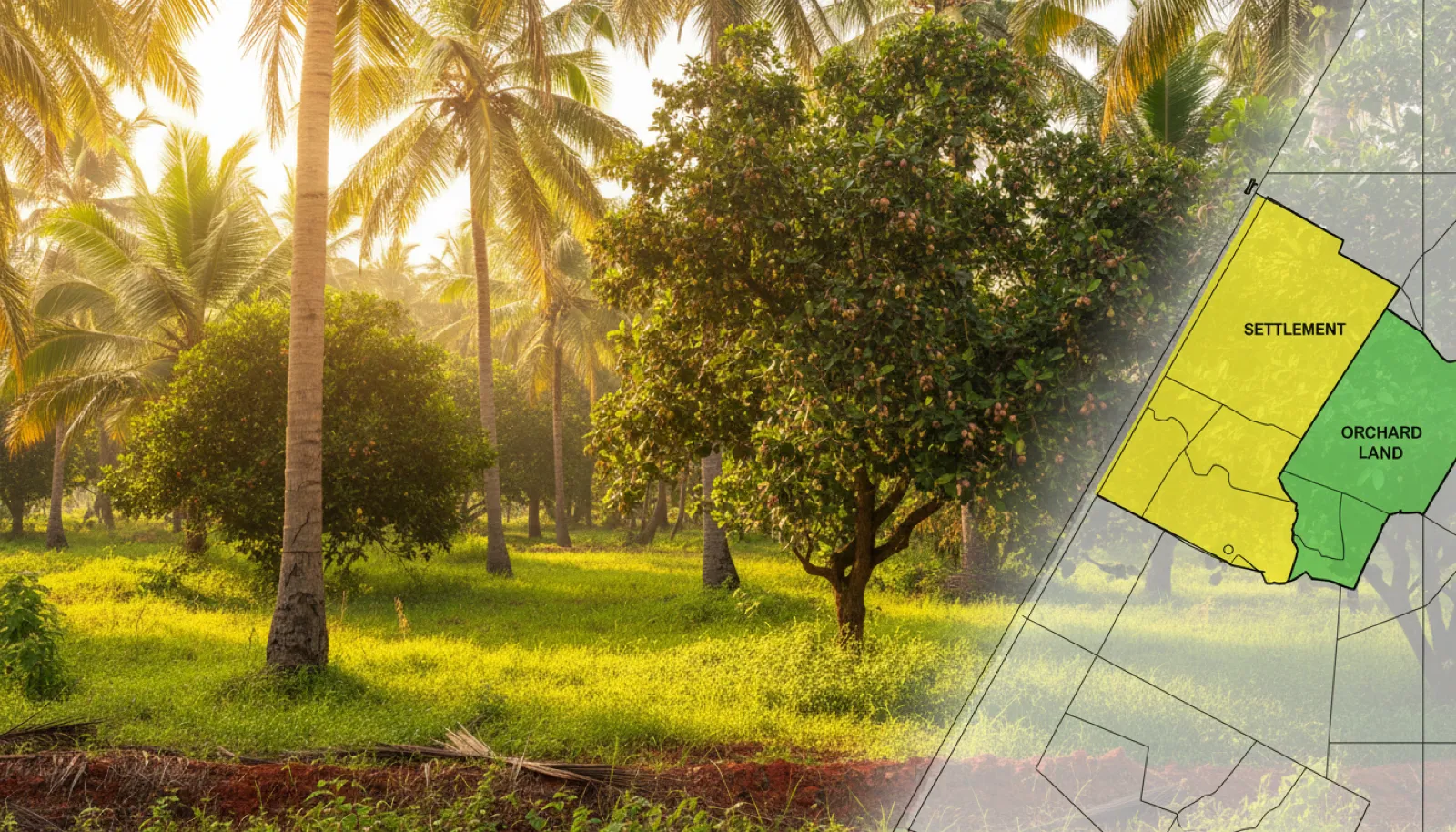
Orchard Land Meaning in Goa: What You Can Actually Do (2026)
What "orchard land" (often misheard as "orchid land") actually means in Goa — the RP21 green zone, what you can and cannot build, why the plots are cheap, and the conversion reality.

Sanad Conversion Cost in Goa: Fees, Slabs & Timeline (2026)
What a conversion Sanad actually costs in Goa — the notified per-sqm fee slabs, the 2024 fee revision, the document checklist, a worked example, and the honest timeline.

How to Buy Land in Sindhudurg: Step-by-Step Guide (2026)
Complete buyer's process for NA plots in Sindhudurg — 7/12 extraction, NA Order verification, CRZ checks, stamp duty, NRI rules. Vengurla/Kondura-specific guidance for 2026.